Dealing with Financial Debt
Project Summary
This project showcases my master's graduation project that I completed for the Dutch Uitvoeringsinstituut Werknemersverzekeringen (UWV). I used a User-Centered Design approach to gain a deeper understanding of the underlying needs of clients with financial debt and the difficulties they face during UWV's repayment process. Through various research and design activities, including a co-creation session with clients from UWV, I designed a service concept to provide UWV clients with financial debt a kinder, softer introduction to UWV's repayment process. Additionally, this concept includes personalized and proactive support through face-to-face or online service meetings, as well as four service touchpoint designs.
10 / 10 by TU Delft supervisors.
Keywords:
Service Design
User-Centered Design
Financial Debt
Co-creation
Contextmapping
Creative Session

Initial problem statement
UWV is a Dutch government organization that assists Dutch citizens who are unemployed or unable to work by helping them find employment and providing benefits. Due to various reasons, clients sometimes are overpaid and have to repay UWV through VFV's repayment process.
Some of UWV's clients have financial debt which affects their ability to take action and be in control of their finances. These clients, in particular, face difficulties during UWV's repayment process (carried out by the department VFV (Verekening Financiele Verplichtingen) UWV wanted to better serve these clients by giving them more control over their financial situation. While UWV had already conducted research on how clients experience the repayment process and is already developing digital services (called the ODI) to support them, further insights were needed on how to address these clients' needs, how to develop solutions to serve these clients, and how to address their underlying needs.


Performed research activities
To address these specific clients' needs, I conducted interviews with five employees from Team Geldzorgen, UWV's specialized team that assists clients with financial debt. Additionally, I reviewed a preexisting study conducted by an external party to gain insights into how clients experience UWV's reclamation process. This study involved 2623 UWV clients who had ongoing or recently completed reclamation from UWV and were asked about their experience with UWV's reclamation process by VFV.
To gather qualitative data on clients' experience with the reclamation process, I analyzed UWV's customer journey 'Ik ontvang een vordering' developed by UWV's Klantexpertise. Using the research documentation for this customer journey, I created a more detailed customer journey specifically tailored to one of the three personas mentioned: Bryan. Bryan not only receives a reclamation from UWV but also has financial debt with other parties, making him an ideal representation of the target group for this project.
Service Blueprint
To connect Bryan's experience with UWV's internal processes, I created a Service Blueprint. This blueprint illustrates the employee actions that affect Bryan's experience and how Bryan's actions impact UWV. By analyzing the service blueprint, I identified nine key insights.


The service blueprint I created to connect the User Experience to the internal processes happening at UWV during VFV's reclamation process.
Show/hide insights

Redefined problem statement
By combining the insights gained from analyzing the service blueprint with the insights obtained from the other research activities, I have identified 15 problem statements. I have categorized these statements into different groups, namely: problems that have already been addressed by UWV's plans for the digital platform (ODI), problems that can be resolved using the ODI, problems that Team Geldzorgen should handle through their training and expertise, and problems related to VFV's services during the reclamation process.
As this project was in collaboration with VFV, I have decided to focus on those problem statements. Specifically, I chose to focus on the four problems that are related to VFV's services because, at the current moment, they only offer one type of service for all clients. However, while my research shows that this service works for roughly 70% of VFV's clients, the research insights also indicate that clients with financial debt (the target group of this project) have an unmet need for more personalized support and attention from VFV, to feel seen and heard by UWV employees.


Project scope
In this design project, I could not address all four problems. To determine which problem to prioritize, I conducted two interviews: one with the former mentor of VFV and another with an experienced financial expert. The primary goals of these interviews were to assess the frequency and severity of each problem based on their personal and professional experiences. In this context, severity refers to the impact that each problem has on clients, while frequency refers to the number of clients facing these financial problems.
Based on the experts' answers and ratings during the interviews, I decided to focus on the two service problems that are most frequent and most severe. More specifically, the fact that the moment clients hear about VFV's reclaim via an unannounced phone call or letter comes as a big and unexpected shock, and the fact that clients currently have an unmet need for more explanation and perspective during VFV reclamation process.


Design Vision
Based on my research activities and the scope of this project, I have formulated a design goal. This goal clearly states what I aim to design for UWV, which clients I would be designing for, and the intended effect the design should have. Additionally, it states that my main focus will be on the initial part of the reclamation process, addressing the significant unexpected shock that clients currently experience when hearing about the reclaim.
I created an interaction vision to outline how clients should experience interacting with this new service. I want clients to feel as if they are "learning how to drive from an experienced driving instructor" for several reasons. First, my research revealed that clients want more explanation and perspective during the reclamation process. They want to know the steps they should take to improve their situation. Second, I want clients to feel confident that they can take these steps themselves once they know what to do. Lastly, I aimed for this interaction to be personal, as during her interview, the experience expert mentioned that the message of having to repay UWV is highly impactful for clients with financial debt and should be conveyed in person rather than over the phone or through a challenging-to-read letter.

The holistic perspective
I realized that in order to achieve the design goal, the problems could not be addressed separately. Instead, a more holistic service approach was necessary. This service approach consists of four key phases centered around a service meeting to introduce and discuss the reclamation from VFV, opposed to the unexpected service calls VFV currently makes. During each of these phases, UWV should take specific actions to evoke a different user experience.
First, clients should be invited to the service meeting. They should be informed of the reason for the invitation without overwhelming them with unnecessary details. Secondly, clients should be provided with step-by-step guidance on how to prepare for the service meeting. If necessary, clients should be offered support during these preparations. Then, during the service meeting, clients should have a personal meeting with a VFV employee. Clients should be able to share their side of the story, the reason for the reclamation should be explained to them, and together the client and employee will seek a suitable solution. Finally, back home clients should be given the means to stay on top of their payments to UWV. They should receive motivation and support to do so, be informed about how to contact VFV if their financial situation changes, and a summary of the meeting should be provided.
Three possible service scenarios
Based on the framework of the holistic perspective, I have created three different service scenarios. Each of these scenarios demonstrates a different approach to how VFV could potentially provide an alternative, more personal, and more supportive service for clients with financial debt.


Co-creation workshop
I organized a co-creation workshop with two clients from UWV and a Team Geldzorgen employee to validate the scenarios and learn from real clients' experiences. I asked both clients to fill in a sensitizing worksheet I created prior to the workshop to reflect on their experience with VFV's reclamation process. This worksheet I sent to their homes along with an invitation for the workshop and two custom-made sticker sheets: one with emotions from the PREMO Toolkit and one with positively and negatively loaded words.
During the workshop, the clients presented and discussed their completed sensitizing assignment with the group. Among other things, clients expressed their desire for a more personal connection with UWV employees. Furthermore, they did not want to repeat their story to different staff members repeatedly. Then, I presented each of the three possible service scenarios and asked them to compose their ideal service scenario on a second worksheet. We discussed their ideal scenarios, including what they liked or disliked about them. They responded positively to all three proposed scenarios, which indicated that the project was headed in a fitting direction but also that there was no one-size-fits-all scenario that would work for all clients.


Co-creation outcomes
Regarding the scenarios, the physical invitation card was considered the most friendly and inviting option. Sending it in a plain envelope without the UWV logo increased the likelihood of clients actually reading it, especially considering that clients generally do not open their mail (according to the team member of Team Geldzorgen). The physical checklist was appreciated for its clarity and usefulness, providing reassurance that clients are fully prepared. Additionally, the availability of a service point and phone number for support was highly valued and needed by some clients.
While clients are open to both digital and in-person meetings, home visits were generally less preferred as they were seen as too personal for some. Furthermore, implementing home visits is less feasible for UWV. All participants greatly appreciated the option to bring an additional person to appointments. Finally, the tear-off calendar was seen as a positive way to keep track of payments and work towards the final payment in a tangible way. However, clients did not find stories of other clients and financial tips necessary, as they usually require more specific advice.
The proposed service
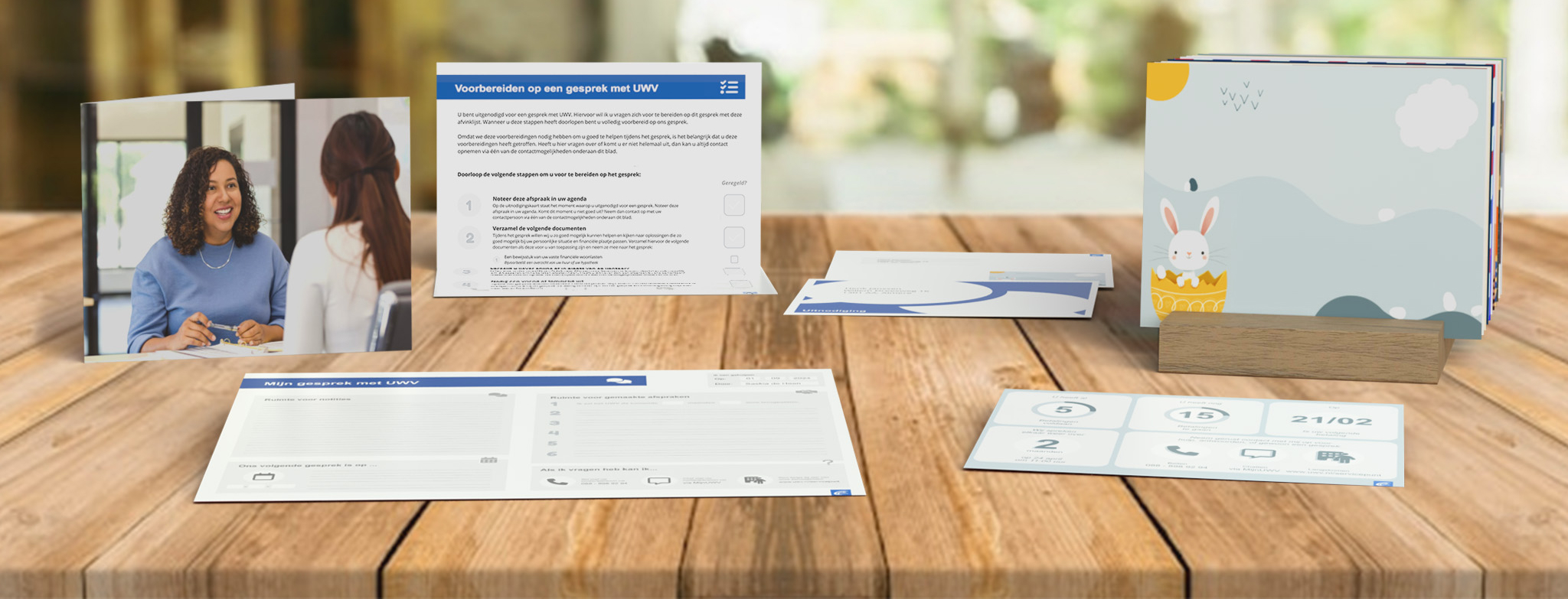
Each of the service touchpoints I designed for the proposed service concept for UWV.


Proposed service scenario
Based on the outcomes of the co-creation workshop, I combined the best elements of the three scenarios into one service concept. The service I propose for clients with financial debt still revolves around the idea of a service meeting instead of unannounced service calls, as the participants of the co-creation session highly welcomed this idea. Similarly, this service consists of the same four phases from the holistic service perspective mentioned earlier.
To explain this proposed service concept, I created a storyboard in which the persona Bryan is offered this new service.


Designed service touchpoints
To validate and evaluate this service concept, I designed and prototyped the four service touchpoints that are part of the proposed concept. By designing and prototyping each of these touchpoints, it made it easier to discuss the otherwise vague service concept. Furthermore, the physical prototypes made the concept much more 'real', as if it could be implemented right away, which generated feedback on a much more detailed design level.
The four touchpoints that were designed and prototyped include: the invitation card and envelope, the preparation checklist, the note-taking sheet for the service meeting, and the monthly update cards and card stand for additional service at home.
Proposed Service Blueprint
To better communicate with UWV which actions they need to take in order to achieve the intended user experience, I have also created a Service Blueprint for the proposed service concept for VFV. This service blueprint combines the intended user experience, service touchpoints, and the actions that UWV needs to take to implement this service.

The Service Blueprint for the proposed service concept for VFV.


Final concept evaluation
I conducted an evaluation test of a service concept with VFV employees (n=6) to assess the viability, feasibility, and potential improvements of the proposed service. I chose VFV employees for this evaluation test because they have daily interactions with the clients and a good understanding of their needs. Unfortunately, it was not possible to also conduct the desirability assessment with real clients within the available timeframe, as it was difficult to contact clients from the target group.
I presented the concept using a printed storyboard and physical prototypes. After discussing the concept with the employees, I asked them to select one of the four main service touchpoints to provide more detailed feedback using a feedback template I created. Following the discussion of the detailed feedback, I concluded the evaluation with a brief interview that included three open-ended questions about the concept. Additionally, I used six 7-point Likert scales to evaluate how well the Design Goal and Interaction Vision were achieved with this concept.


Evaluation outcomes
While the proposed service may not be suitable for everyone, according to VFV employees, it is a step in the right direction for some clients. This is reflected by the ratings given by employees when asked about the achievement of the Design Goal and Interaction Vision with this design. This service was seen as beneficial for clients with financial debt, as well as other types of clients, including the elderly, clients from foreign countries, and mentally or physically impaired clients. Overall, this service is considered an improvement over VFV's current services.
The employees generally responded positively to the proposed service, but they also had feedback on how each of the service touchpoint designs could be improved (as mentioned in detail in my thesis). Furthermore, the employees mentioned several implementation challenges, such as the added pressure on VFV's capacity, and privacy and safety concerns, which should be further looked into before implementing this service. However, their initial response was very positive.


Recomendations
I concluded this project by writing ten recommendations for UWV after reflecting on both the outcomes of this project and the project as a whole. Five of these recommendations focus on the proposed service concept, providing my view on how UWV should further develop and evaluate it to assess its real-world effectiveness before implementation. The remaining five recommendations offer actionable advice on how UWV can use the insights and methodologies from this graduation project to make their overall way of working more user-centered and better align their current services with their real clients' needs.


The publication of my thesis
This whole project I documented in my master thesis and summarized with a poster to showcase the project. Both my thesis, the appendices, and the poster showcase can be downloaded on the TU Delft repository.